 HFD Team
 Tattoo Pain Chart: Most and Least Painful Places to Get a Tattoo
Tattoos have evolved from ancient cultural traditions into a popular form of self-expression. But before getting one, many people have the same question: How much will a tattoo hurt?
The answer depends on several factors, including the tattoo’s location, size, session length, your individual pain tolerance, and the tattoo artist’s technique. Some areas are generally more comfortable, while others tend to be more sensitive.
Understanding tattoo pain can help you choose a suitable placement, especially if this is your first tattoo.
What Determines Tattoo Pain?
Tattoo pain varies from person to person, but several factors can influence how intense it feels:
Nerve sensitivity: Areas with greater sensitivity can feel more uncomfortable.
Skin and soft-tissue thickness: Areas with more cushioning may be easier to tolerate than areas with very little soft tissue.
Proximity to bone: Places with little cushioning around the bone can make the vibration and needle sensation feel more intense.
Tattoo size: Larger designs usually require longer sessions, which can increase discomfort and fatigue.
Artist technique: Needle depth, speed, and technique can affect the tattooing experience.
Individual pain tolerance: Everyone experiences pain differently.
For these reasons, any tattoo pain chart should be treated as a general guide rather than a scientific 1–10 measurement.
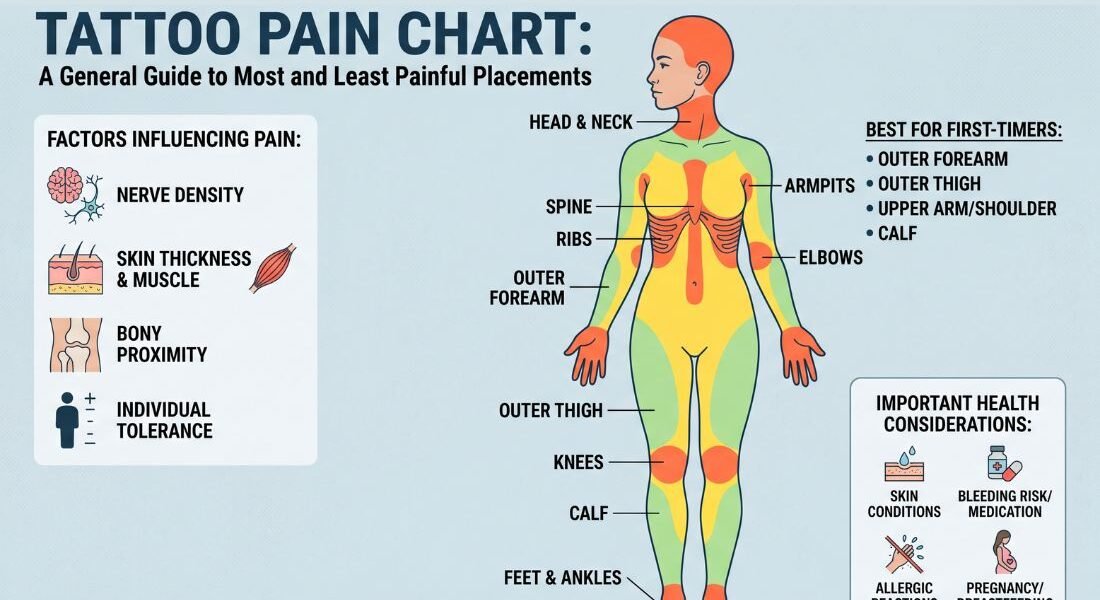
Tattoo Pain Chart: Least to Most Painful Areas
| General discomfort | Common tattoo placements |
| Lower | Outer forearm, outer upper arm, shoulder, outer thigh, calf, upper back |
| Moderate | Inner arm, chest, stomach, hips |
| Higher | Ribs, hands, fingers, feet, ankles, knees, elbows, spine, armpits, head and neck |
The exact experience can vary even within the same body area.
Least Painful Tattoo Placements
If you’re getting your first tattoo, areas with more soft-tissue coverage are often easier to tolerate.
Outer forearm: The outer forearm is a popular beginner-friendly location because it generally has a good amount of soft tissue and is relatively accessible to the artist.
Outer upper arm and shoulder: These areas are commonly considered manageable because they have more muscle and soft tissue than some highly sensitive locations.
Outer thigh: The outer thigh often has substantial soft-tissue coverage, making it one of the more comfortable choices for many people.
Calf: The calf can be a manageable location, although discomfort may increase when the tattoo approaches the shin or other bony areas.
Upper back: The upper back generally offers a broad surface with reasonable soft-tissue coverage. Areas closer to the spine may feel more sensitive.
Moderately Painful Tattoo Placements
Some locations fall somewhere between comfortable and highly sensitive.
Inner arm: The inner arm can feel more sensitive than the outer arm because the skin is softer and the area can be more sensitive.
Chest: Chest tattoos can vary significantly in discomfort. Areas closer to the sternum and collarbone may feel more intense.
Stomach: Abdominal tattoos can range from moderate to uncomfortable depending on the exact location and individual sensitivity.
Hips: The amount of soft tissue varies around the hips, so discomfort can increase when the tattoo approaches bony areas.
Most Painful Tattoo Placements
Certain areas are commonly reported as more uncomfortable because they have less soft-tissue cushioning or are particularly sensitive.
Ribs: Rib tattoos are often considered challenging because the skin is relatively close to the ribs and the area moves continuously as you breathe.
Hands and fingers: These areas have relatively little cushioning and can be highly sensitive.
Feet and ankles: The skin around the feet and ankles has limited cushioning in many locations, which can make tattooing uncomfortable.
Elbows and knees: Tattooing directly over or around these joints can be uncomfortable because of the limited soft-tissue coverage and sensitive skin.
Spine: Tattoos along the spine can produce strong vibration and discomfort, particularly in areas with less cushioning.
Armpits: The armpit is a particularly sensitive area and is generally considered one of the more difficult tattoo placements.
Neck and head: These areas can be highly sensitive, and the experience varies considerably from person to person.
What Else Affects Tattoo Pain?
Placement isn’t the only factor that matters. The experience can change throughout the session.
A large tattoo may become more uncomfortable simply because the skin is being worked on for a longer period. Long sessions can also cause physical and mental fatigue.
Your mental state can also influence how you perceive discomfort. Feeling anxious or tense may make the experience feel more difficult, while staying relaxed and prepared can make it easier to manage.
The tattoo artist’s experience and technique also matter. A professional artist should use appropriate equipment and techniques while working within safe tattooing practices.
Best Tattoo Placements for First-Timers
If you’re getting your first tattoo and are concerned about pain, consider a location that is generally easier to tolerate, such as the:
- Outer forearm
- Outer upper arm
- Shoulder
- Outer thigh
- Calf
- Upper back
Starting with a smaller design can also help you understand how your body responds before committing to a larger or more sensitive placement.
Health Factors to Consider Before Getting a Tattoo
Pain isn’t the only consideration before getting tattooed. Your skin and general health can affect healing and the overall experience.
Skin conditions: Avoid tattooing over irritated, infected, sunburned, or damaged skin. If you have a skin condition affecting the area, speak with a healthcare professional before getting tattooed.
Bleeding problems or blood-thinning medication: These can increase bleeding during tattooing. If you have a bleeding disorder or take medication that affects blood clotting, discuss tattooing with your healthcare provider first.
Allergic reactions: Some people can develop reactions to tattoo pigments. If you have a history of allergies or sensitive skin, discuss your concerns with a healthcare professional and your tattoo artist.
Pregnancy or breastfeeding: Some people choose to postpone tattooing during pregnancy or breastfeeding because of infection and healing concerns. If this applies to you, discuss the decision with your healthcare provider.
Alcohol before a session: Avoid drinking alcohol before getting tattooed. It may increase bleeding and can affect hydration, judgment, and your ability to remain comfortable during the appointment.
Keloid-prone skin: If your skin tends to form raised scars, discuss the risks with a healthcare professional before getting a tattoo.
Blood donation: Blood donation rules after getting a tattoo vary between countries and blood services. Check with your local blood donation organization for its current requirements.
Tattoos Then and Now
Tattooing has existed for thousands of years. One of the oldest known examples is Ötzi the Iceman, a 5,000-year-old mummy discovered in the Alps. His body had more than 60 tattoos, many consisting of simple lines. Researchers have suggested that some may have had therapeutic purposes.
Tattooing has also played important cultural roles in different societies. In Polynesian cultures, tattoos have traditionally represented identity, status, achievements, and community connections. In ancient Egypt, archaeological evidence shows that tattooing was practiced as part of cultural and possibly protective or therapeutic traditions.
Modern tattooing changed significantly with the development of the electric tattoo machine in the late 19th century. Tattooing eventually moved from traditional and subcultural settings into mainstream popular culture.
Today, people choose tattoos for many reasons, from personal memories and cultural identity to art and self-expression.
The Bottom Line
Tattoo pain is real, but the experience is different for everyone. Areas such as the outer forearm, upper arm, shoulder, and outer thigh are generally considered more manageable, while areas such as the ribs, hands, feet, armpits, and certain bony locations tend to be more sensitive.
There is no universal tattoo pain scale that applies to everyone. Your placement, tattoo size, session length, artist’s technique, and individual sensitivity all play a role.
If you’re getting your first tattoo, choosing a generally lower-discomfort area and starting with a smaller design can make the experience easier. Most importantly, choose a reputable professional tattoo artist and make sure your skin is healthy before the appointment.
The goal isn’t to avoid all discomfort. It’s to understand what you’re getting into and choose a tattoo placement that works for both your design and your comfort level.