
 HFD Team
Why you feel it right after drinking
That warm, loose, slightly floaty feeling right after a drink is alcohol hitting your bloodstream fast. It gets absorbed through your stomach and small intestine, then travels straight to your brain, where it slows down the signals between neurons. That slowdown is what makes you feel relaxed, a little less inhibited, and sometimes dizzy or slow to react if you have had enough. Your liver starts working on breaking it down almost immediately, but it can only process so much at once, which is why the feeling builds if you keep drinking faster than your body can keep up.
Did you ever wonder how long its gonna stay in your body
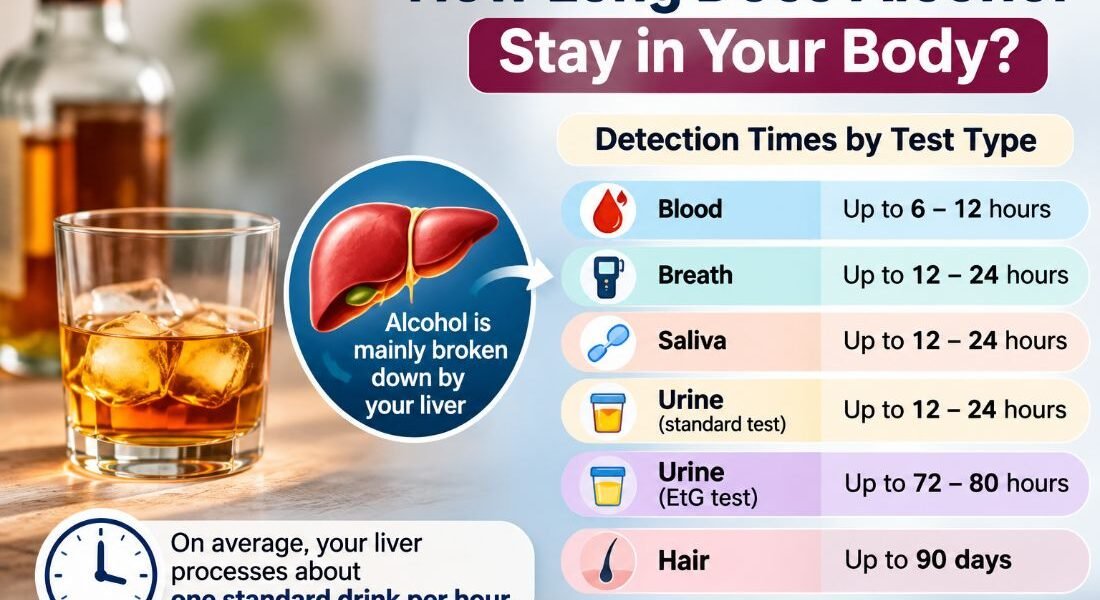
Short answer: longer than you’d think. Your liver clears alcohol itself from your blood in about 6 to 12 hours after your last drink, working through roughly one standard drink per hour no matter how much you had overall. But alcohol leaves traces and byproducts behind that stick around a lot longer depending on where someone looks for them, anywhere from about a day for breath and standard urine tests to as long as 90 days in a hair sample. The rest of this post breaks down exactly how that works test by test.
How your body actually processes alcohol
When you drink, alcohol moves into your bloodstream through your stomach and small intestine, then travels to your liver, where enzymes break it down. The liver can only work through so much at once, which is why drinking faster than your body can process it raises your blood alcohol concentration, commonly shortened to BAC.
On average, BAC drops by about 0.015 percent per hour. A person who stops drinking at a BAC of 0.08 percent, the standard legal limit for driving in many places, will generally take around five to six hours to return to a BAC near zero. Heavier drinking sessions take proportionally longer, and nothing speeds this process up. Coffee, cold showers, and exercise might make you feel more alert, but none of them change how quickly your liver metabolizes alcohol.
Detection windows by test type
Different tests look for different things, which is why detection times vary so much. Some check for alcohol itself, while others check for metabolites, the byproducts your body creates while breaking alcohol down, which can linger after the alcohol itself is gone.
|
Test type |
Typical detection window |
|
Blood |
Up to about 6 to 12 hours |
|
Breath |
Up to about 12 to 24 hours |
|
Saliva |
Up to about 12 to 24 hours |
|
Urine (standard test) |
Up to about 12 to 24 hours |
|
Urine (EtG metabolite test) |
Up to about 72 to 80 hours |
|
Hair |
Up to about 90 days |
Blood
A standard blood test measures your actual blood alcohol concentration and is most useful shortly after drinking. Once your liver finishes processing the alcohol, a blood test will no longer pick it up, which is why this window is the shortest of the group.
Breath
Breathalyzers measure alcohol vapor in your lungs, which correlates closely with your blood alcohol level. This is the method most familiar from law enforcement traffic stops, since it gives a fast, noninvasive reading. Alcohol can show up on a breath test within minutes of your first drink and remain detectable for up to a day afterward, depending on how much you drank.
Saliva
Saliva testing works on a similar timeline to breath testing and is sometimes used as a quick screening method since samples are easy to collect.
Urine
A standard urine test has a detection window similar to breath and blood testing. However, more sensitive urine tests look for a metabolite called ethyl glucuronide, often abbreviated EtG, which your body produces as it breaks down alcohol. EtG can be detected in urine for several days after drinking, far longer than the alcohol itself remains in your system, which is why EtG testing is often used in settings that require strict sobriety monitoring.
Hair
Hair follicle testing has by far the longest detection window of any method. As hair grows, it incorporates traces of substances circulating in your body, including alcohol metabolites. Because hair grows slowly and steadily, a standard hair sample can reflect drinking patterns going back about 90 days, though this method is better at identifying patterns of heavy drinking over time than detecting a single isolated drink.
What affects how long alcohol stays in your system
No two people process alcohol at exactly the same rate. Several factors can speed up or slow down how long it takes your body to clear alcohol, and how long it remains detectable:
- Body weight and composition. Alcohol distributes through body water, so people with more body water relative to their size tend to reach a lower peak BAC from the same amount of alcohol.
- Biological sex. On average, women tend to have less body water and lower levels of the enzyme that breaks down alcohol in the stomach, which can lead to higher BAC from the same amount consumed compared to men of similar weight.
- Food intake. Eating before or while drinking slows how quickly alcohol is absorbed into the bloodstream, which can lower peak BAC, though it does not change the total amount of alcohol your liver eventually has to process.
- Liver health. Since the liver does most of the work of breaking down alcohol, existing liver conditions can slow the whole process considerably.
- Amount and pace of drinking. Drinking heavily or quickly raises peak BAC and extends the total time needed to return to zero, since the liver still only processes about one drink per hour.
- Medications. Certain medications can interact with alcohol metabolism, either slowing it down or intensifying its effects.
Common questions
Does drinking water flush alcohol out faster? Staying hydrated supports your overall health and can ease some hangover symptoms, but it does not speed up how quickly your liver metabolizes alcohol.
Can I pass a breath test after sleeping it off? It depends entirely on how much you drank and when. If you drank heavily late at night, you may still have measurable alcohol in your system the next morning, even if you feel fine.
Why do hair tests detect alcohol so much longer than other methods? Hair grows gradually and retains a record of substances in your bloodstream over that growth period, unlike blood, breath, or urine, which reflect only recent exposure.
Is there any way to speed up metabolism of alcohol? No reliable method exists to make your liver process alcohol faster. Time is the only factor that lowers your BAC.
The bottom line
Alcohol itself typically clears your blood within half a day, but depending on the test, traces or metabolites can be detectable for anywhere from several hours to several months. If you need to know for certain how alcohol might affect a medical test, a job requirement, or a legal situation, it is worth speaking with a doctor or the organization requesting the test, since individual circumstances can shift these general windows considerably.
This article is for general informational purposes and is not a substitute for medical advice. If you have concerns about your own alcohol use or health, consider speaking with a healthcare provider.
Also Read : Can You Drink Liquid IV Everyday?